1. Entwodiksyon
This manual provides comprehensive instructions for the ACASIS 4K60fps Video Capture Card (Model VC-007PRO). This device is designed for capturing and streaming high-quality video and audio from various sources, including gaming consoles and cameras, to a computer for live broadcasting or recording. It supports 4K60fps video capture, VRR, and features ultra-low latency.
2. Pake kontni
Verifye ke tout atik yo prezan nan pake pwodwi ou a:
- ACASIS 4K60fps Video Capture Card (VC-007PRO)
- HDMI kab
- USB-C pou USB-A kab
- Gid enstalasyon (dokiman sa a)
3. Pwodwi souview
The ACASIS 4K60fps Video Capture Card is a compact device with multiple ports for connectivity. Understanding its layout is crucial for proper setup and operation.

Imaj: Devan view of the ACASIS 4K60fps Video Capture Card, showing the HDMI In and HDMI Out ports, and the USB-C port for connection to a computer.
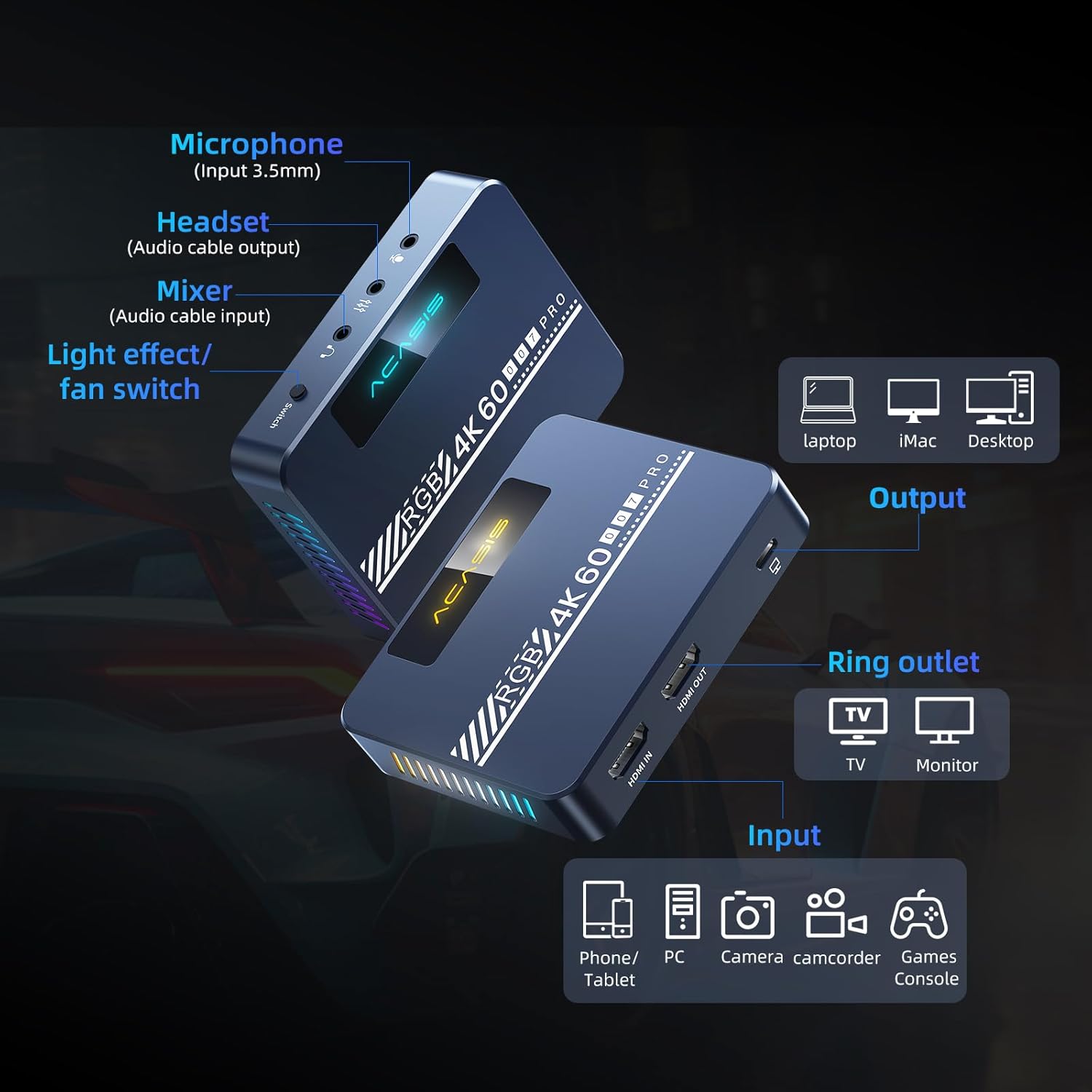
Image: Detailed diagram illustrating the various input and output ports on the capture card, including Microphone (Input 3.5mm), Headset (Audio cable output), Mixer (Audio cable input), Light effect/fan switch, HDMI IN, HDMI OUT, and USB-C output to PC/Mac.
Konpozan kle:
- HDMI nan: Connects to the source device (e.g., game console, camera).
- HDMI SOTI: Connects to a display (e.g., TV, monitor) for pass-through viewing.
- USB-C Sòti: Connects to your computer (PC/Mac) for data transfer and power.
- Antre Mikwofòn (3.5mm): Pou konekte yon mikwofòn ekstèn.
- Headset Output (3.5mm): For connecting headphones or a headset for audio monitoring.
- Mixer Input (3.5mm): For connecting an audio mixer.
- Light Effect/Fan Switch: Controls the RGB lighting and cooling fan.
4. Gid Enstalasyon
Follow these steps to connect your ACASIS 4K60fps Video Capture Card to your devices.
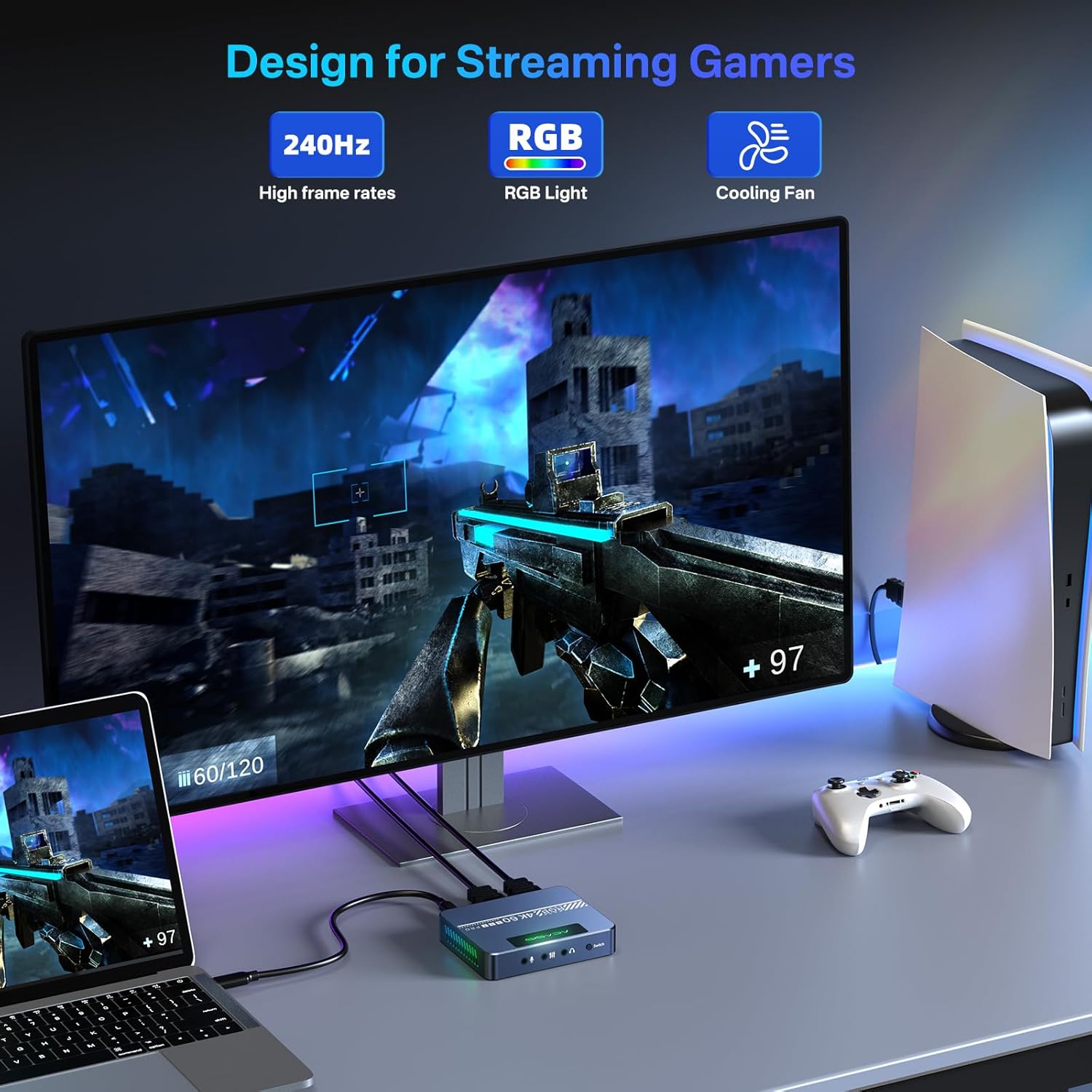
Image: A typical setup showing a game console (PS5) connected via HDMI to the capture card's HDMI IN, the capture card's HDMI OUT connected to a monitor, and the capture card's USB-C port connected to a laptop for streaming/recording.
Etap Koneksyon:
- Konekte Aparèy Sous: Use an HDMI cable to connect your source device (e.g., Xbox Series X/S, Xbox One, PS5, PS4/Pro, PC, camera) to the HDMI-AN pò sou kat kaptire a.
- Konekte Ekspozisyon an (Si ou vle): Use another HDMI cable to connect your display (e.g., TV, monitor) to the HDMI SOTI port on the capture card. This allows for pass-through viewing of your source device.
- Konekte ak òdinatè: Connect the provided USB-C to USB-A cable (or a USB-C to USB-C cable if your computer supports it) from the capture card's USB-C Sòti port to an available USB port on your computer (PC/Mac). The device is plug-and-play and typically does not require driver installation.
- Konekte Aparèy Odyo yo (Si ou vle):
- For microphone input, connect your 3.5mm microphone to the Antre mikwofòn pò.
- For audio monitoring, connect your 3.5mm headset or headphones to the Headset Sòti pò.
- For external audio mixing, connect your audio mixer to the Mixer Input pò.
5. Operasyon Enstriksyon
This section details how to use the capture card with streaming and recording software, using OBS Studio as an example.
Software Setup (OBS Studio Example):
The ACASIS capture card is compatible with various platforms and applications, including OBS, Streamlabs, Vmix, Zoom, and Microsoft Teams. For streaming and recording, OBS Studio is a commonly used application.
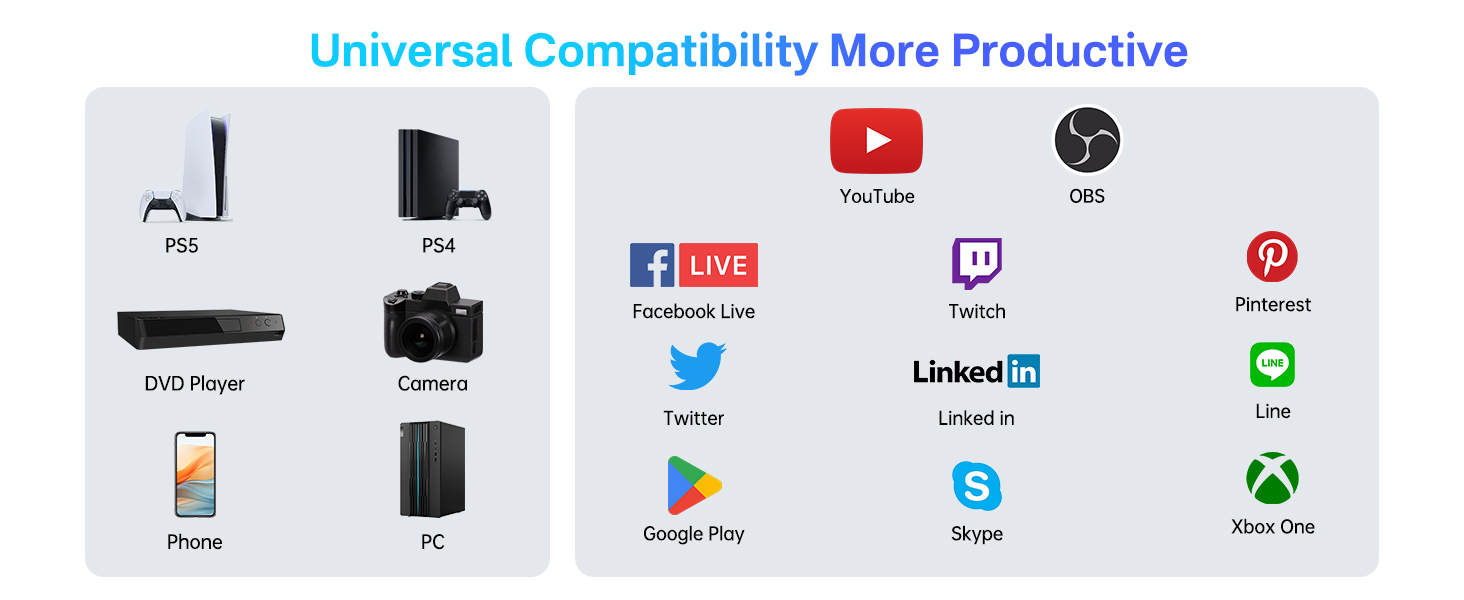
Image: A five-step guide for adding the video capture device in OBS Studio. Steps include opening OBS, clicking '+' in Sources, selecting 'Video Capture Device', creating a new source, and configuring properties.
- Open OBS Software: Launch OBS Studio on your computer.
- Ajoute yon sous videyo: In the 'Sources' panel, click the '+' icon.
- Chwazi aparèy kaptire videyo: From the list, choose 'Aparèy Capture Videyo'.
- Create/Select Source: You can create a new source or select an existing device name. Click 'OK'.
- Configure Properties: In the properties window for the video capture device, set the following:
- Rezolisyon/FPS Kalite: Set to 'Custom'.
- Rezolisyon: Select '1920x1080' (or desired resolution up to 4K).
- FPS: Set to '60'.
- Fòma videyo: Select 'YUY2'.
- Espas koulè: Select 'Rec.709'.
- Ranje koulè: Select 'Plen'.
Recording and Streaming Settings (OBS Studio):
For optimal performance, adjust your OBS output settings. These settings are optional if you are not recording or streaming.

Image: A screenshot of OBS Studio's output settings for recording, highlighting video bitrate, encoder, audio bitrate, recording quality, and format.

Image: A screenshot of OBS Studio's output settings for streaming, showing where to enter the stream key and start streaming.
- Anviwònman aksè: In OBS, go to 'Anviwònman' (usually in the bottom right corner).
- Output Settings (Recording): Navige nan 'Sòti' tab and then 'Anrejistreman'.
- Kalite anrejistreman: Set to 'Indistinguishable Quality, Large File Gwosè' for high-quality recordings.
- Fòma anrejistreman: 'MP4' is generally recommended for compatibility.
- Ankode: Use 'Hardware (NVENC)' if available for better performance, otherwise 'Software (x264)'.
- Bitrate videyo: Adjust based on desired quality and storage space (e.g., 8000 Kbps for 1080p).
- Bitrate odyo: Set to '128' or higher.
- Output Settings (Streaming): Navige nan 'Sòti' tab and then 'Difizyon'.
- Bitrate videyo: Adjust according to your internet upload speed and platform recommendations.
- Ankode: Use 'Hardware (NVENC)' if available.
- Bitrate odyo: Set to '128' or higher.
- Anviwònman Videyo: In the 'Videyo' tab, ensure 'Base (Canvas) Resolution' and 'Rezolisyon Sòti (Ajoute)' are set appropriately (e.g., 1920x1080). Set 'Valè FPS Komen yo' to '60'.
6. VRR Support
The ACASIS capture card supports Variable Refresh Rate (VRR), which helps eliminate screen tearing and stuttering for a smoother visual experience, especially in gaming. Ensure your source device and display also support VRR for this feature to function.

Image: A side-by-side comparison demonstrating the visual difference between VRR Open (smooth image) and VRR Close (image with tearing artifacts) on a gaming display.
When VRR is active, the display's refresh rate dynamically adjusts to match the frame rate output by the source device, resulting in a more fluid and responsive experience.
7. Cooling Fan and RGB Lighting
The capture card features an upgraded cooling fan to prevent overheating during extended use, ensuring stable performance. It also includes customizable RGB lighting effects.

Imaj: Yon entèn view of the capture card highlighting the integrated cooling fan, designed to dissipate heat and maintain optimal operating temperatures.
Kontwòl:
- La 'Light Effect/Fan Switch' button on the device controls both the cooling fan and the RGB lighting.
- A single press typically toggles the fan on/off.
- Double-clicking the button may cycle through RGB lighting modes or turn the lighting on/off.
8. Konpatibilite
The ACASIS 4K60fps Video Capture Card offers broad compatibility with various hardware and software platforms.

Image: A chart illustrating the universal compatibility of the capture card with various input devices (PS5, PS4, DVD Player, Camera, Phone, PC) and output platforms/applications (YouTube, OBS, Facebook Live, Twitch, Pinterest, Twitter, LinkedIn, Line, Google Play, Skype, Xbox One).
Materyèl ki sipòte:
- Gaming Consoles: Xbox Series X/S, Xbox One, PS5, PS4/Pro, Nintendo Switch
- Computers: PC (Windows), Mac (macOS)
- Cameras: DSLR, Camcorders, Action Cams
- Other HDMI Sources: DVD Players, Tablets, Phones (with appropriate adapters)
Supported Software/Platforms:
- OBS Studio
- Streamlabs OBS
- Vmix
- Zoom
- Ekip Microsoft
- YouTube
- Twitch
- Jwèt Facebook
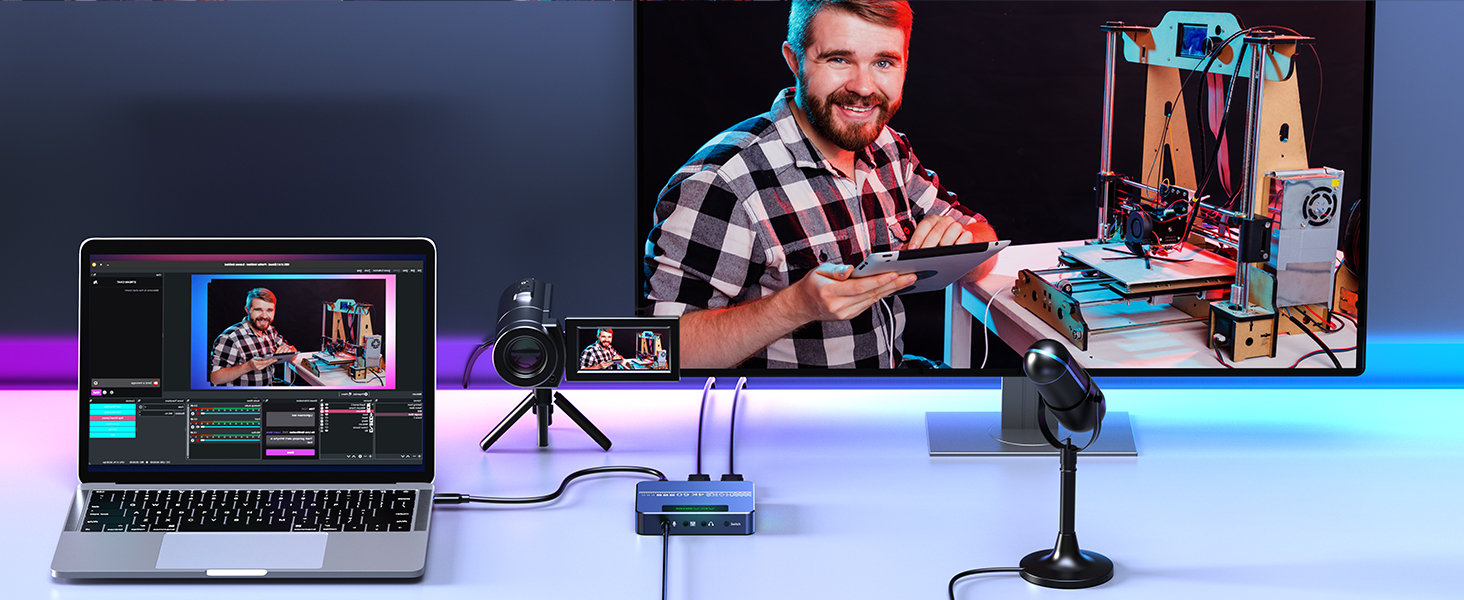
Image: A setup demonstrating the capture card's use in a video conferencing scenario, connecting a camera to a computer for enhanced video input.
NAN. Depanaj
Seksyon sa a adrese pwoblèm komen ou ka rankontre epi li bay solisyon potansyèl.
No Signal / Black Screen:
- Tcheke Koneksyon: Asire w tout kab HDMI ak USB yo byen konekte.
- HDCP Content: Aparèy sa a DOES NOT SUPPORT HDCP. If your source device is outputting HDCP-protected content (e.g., certain streaming services, Blu-ray players), you will not get a signal. Disable HDCP on your source device if possible, or use a non-HDCP source.
- 4K Display Requirement: To achieve 4K resolution, ensure your display and source device are 4K compatible.
- Kalite kab: Use high-quality HDMI cables that support 4K60fps transmission. Lower quality cables may cause signal issues or limit resolution/frame rate.
- Lojisyèl konte genyen: Verify that the capture card is correctly selected as the video source in your streaming/recording software (e.g., OBS) and that resolution/FPS settings are appropriate.
Pwoblèm odyo:
- Tcheke Paramèt Odyo yo: In your computer's sound settings and streaming software, ensure the correct audio input (from the capture card) and output devices are selected.
- Microphone/Headset Connections: Confirm external audio devices are properly plugged into the capture card's 3.5mm ports.
Latency/Lag:
- Pò USB: Ensure the capture card is connected to a USB 3.0 (or higher) port on your computer for optimal bandwidth. USB 2.0 ports may introduce higher latency.
- Pèfòmans òdinatè: Ensure your computer meets the minimum system requirements for streaming/recording at your desired resolution and frame rate. Close unnecessary applications.
- Anviwònman lojisyèl: Adjust buffer settings in your streaming software (e.g., OBS) if available.
4K Resolution Not Working:
- 4K Monitor/Device: As noted, 4K output requires a 4K compatible monitor or device.
- Source Device Settings: Ensure your source device (e.g., console) is configured to output 4K resolution.
- OBS Settings: Double-check that the resolution in OBS is set to 4K (e.g., 3840x2160) if your system supports it.
10. Espesifikasyon
Technical specifications for the ACASIS 4K60fps Video Capture Card (Model VC-007PRO).
| Karakteristik | Spesifikasyon |
|---|---|
| Mak | ACASIS |
| Nimewo Modèl | VC-007PRO |
| Entèfas Materyèl | USB Kalite C |
| Rezolisyon Capture Videyo | 4K 60fps (Input/Pass-through), 4K 60fps (Recording) |
| Sistèm operasyon sipò | Windows, macOS |
| Platfòm pyès ki nan konpitè | Xbox Series X/S, Xbox One, PS5, PS4/Pro, PC/Mac |
| Pwa atik | 4.2 ons |
| Dimansyon pake | 6.14 x 4.57 x 2.44 pous |
| VRR Support | Wi |
| Sipò HDCP | Non |
11. Antretyen
To ensure the longevity and optimal performance of your ACASIS 4K60fps Video Capture Card, follow these maintenance guidelines:
- Netwayaj: Sèvi ak yon twal mou epi sèk pou netwaye deyò aparèy la. Evite itilize pwodui netwayaj likid oswa materyèl abrazif.
- Vantilasyon: Ensure the device's ventilation openings are not obstructed to allow proper airflow for the cooling fan.
- Depo: Store the capture card in a cool, dry place away from direct sunlight and extreme temperatures when not in use.
- Manyen: Handle the device with care to avoid physical damage to ports or the casing.
12. Garanti ak sipò
For technical assistance, warranty information, or any inquiries regarding your ACASIS 4K60fps Video Capture Card, please contact ACASIS customer support.
- Sipò Imèl: support@acasis.com
- Sèvis sou entènèt: 7x24 hours online support is available.
Please refer to the official ACASIS website or your purchase documentation for the most up-to-date warranty terms and conditions.


