1. Entwodiksyon
This manual provides detailed instructions for the installation, operation, and maintenance of your OOYCYOO MPPT 60A Solar Charge Controller. This device is designed to efficiently manage power flow from your solar panels to your battery bank, ensuring optimal charging and system protection. It supports automatic 12V/24V system voltage identification and is compatible with various battery types.
Key features include a backlit LCD display, a 4-stage battery charging algorithm, and comprehensive protection functions.
2. Enstriksyon Sekirite
- Toujou konekte batri a an premye, answit panèl solè a, epi finalman chaj la. Dekonekte nan lòd envès.
- Ensure all wiring is correctly polarized to prevent damage.
- Do not connect inverters or inductive loads directly to the controller's load terminals.
- Enstale kontwolè a nan yon zòn ki byen ayere, lwen materyèl ki ka pran dife.
- The controller generates heat during operation; ensure adequate airflow. The integrated cooling fan activates when the temperature exceeds 45°C and turns off below 40°C.
- Use appropriate circuit breakers and fuses for all connections.
- This device is for indoor use only. Protect it from water and moisture.
3. Pwodwi souview
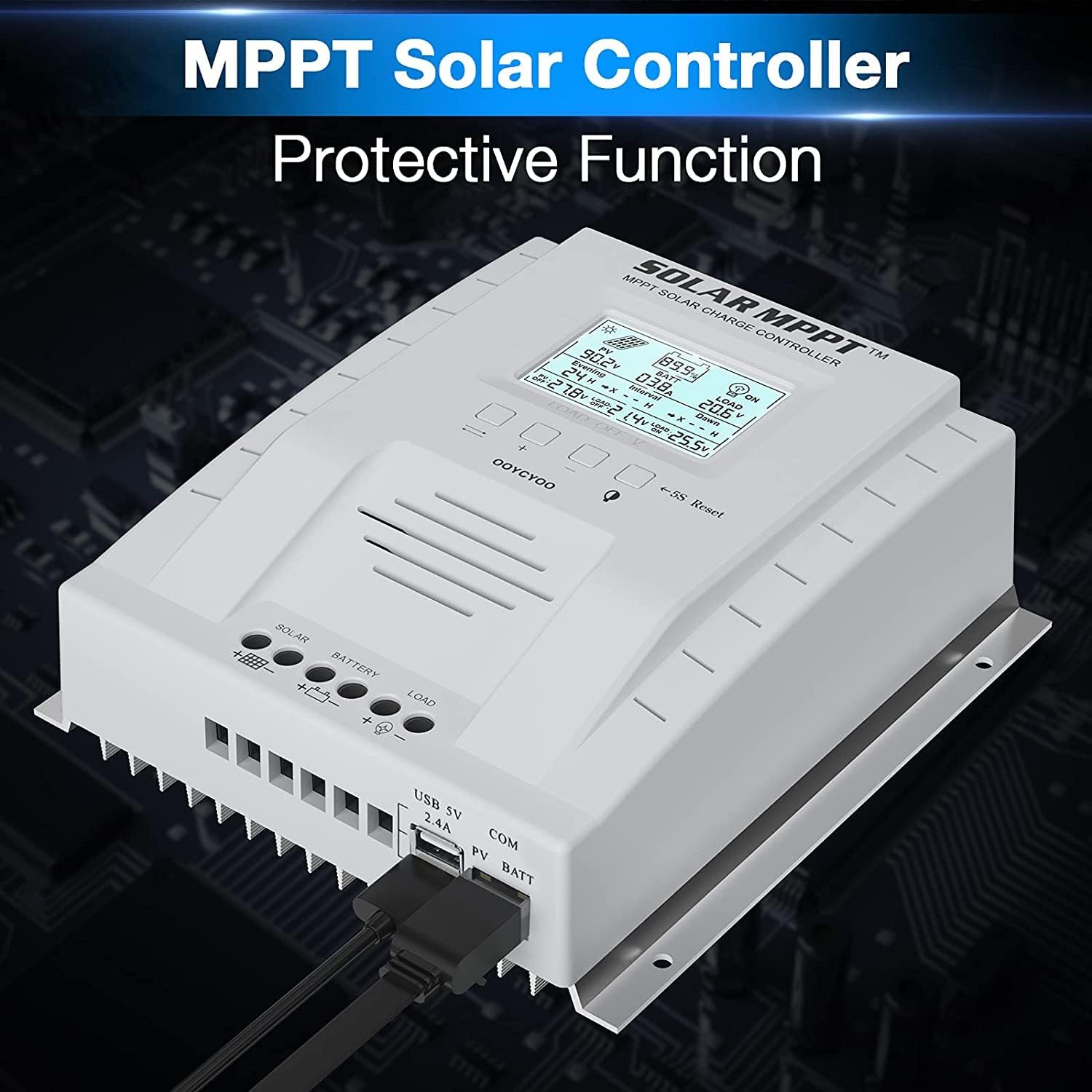
The OOYCYOO MPPT 60A Solar Charge Controller is designed for efficient solar power management. It features an LCD display for real-time data, multiple protection functions, and support for various battery types.
3.1 Kontni pake a
- 1 x OOYCYOO MPPT 60A Solar Charge Controller
- 1 x Capteur Tanperati
- 1 x Manyèl Itilizatè (Angle)
3.2 Idantifikasyon konpozan

The controller features a clear LCD display on the front for monitoring system status. Below the display are control buttons for navigation and settings. Connection terminals for solar panels, battery, and load are located at the bottom. USB ports and an RS485 communication port are on the side.
4. Enstalasyon ak Enstalasyon
Proper installation is crucial for the safe and efficient operation of your solar charge controller. Follow these steps carefully.
4.1 Monte kontwolè a
- Choose a dry, well-ventilated location, protected from direct sunlight, high temperatures, and water.
- Ensure there is sufficient space around the controller for heat dissipation.
- Mount the controller vertically on a wall or stable surface using the provided mounting holes.
4.2 Koneksyon fil elektrik
Follow the connection order precisely to avoid damage to the controller or other components.
- Konekte batri a: Connect the positive and negative terminals of the battery to the corresponding battery terminals on the controller. Ensure correct polarity. The controller will automatically detect the system voltage (12V oswa 24V).
- Konekte Panno Solè yo: Connect the positive and negative leads from your solar panel array to the corresponding PV terminals on the controller. Ensure correct polarity. Do not exceed the maximum PV input voltage nan 100V DC.
- Konekte chaj la (Si ou vle): Connect your DC loads to the load terminals on the controller. Note that the load output is for DC loads only. Do not connect inverters or inductive loads directly to these terminals.
- Connect the Remote Temperature Sensor: Plug the temperature sensor into its dedicated port. This sensor helps the controller optimize charging based on battery temperature.

Nòt enpòtan: Always connect the battery first and disconnect the solar panel last. Incorrect connection order can damage the controller.
5. Operasyon Enstriksyon
Once installed, the controller will begin operation automatically. The LCD display provides real-time system information.
5.1 Ekran LCD ak bouton

The backlit LCD displays critical system parameters such as PV voltage, batri voltage, charging current, load current, and accumulated energy (KWH). The four buttons below the display are used for navigation and settings adjustment:
- Kle baskile: Used to cycle through display screens or confirm selections.
- '+' (Plus) Key: Increases values or moves forward in menus.
- '-' (Minus) Key: Decreases values or moves backward in menus.
- Manual Switch Load Key: Toggles the load output on/off manually.
- 5S Reset: Peze epi kenbe pou 5 segonn retabli paramèt faktori yo.
5.2 Battery Charging Algorithm
The controller utilizes a 4-stagalgoritm chaje pou optimize lavi batri ak pèfòmans:
- Chaj esansyèl: Charges the battery at maximum current until the voltage rive nan boost voltage.
- Ranfòse Chaj: Chaj nan yon volim konstantage for a set period to ensure full charge.
- Chaje Flote: Kenbe batri a nan yon volim ki pi batage to prevent self-discharge and overcharging.
- Equalization (for specific battery types): Chaje batri a twòp detanzantan pou balanse volim selil la.tages epi anpeche silfasyon.
5.3 Supported Battery Types
The controller is compatible with various battery types, including:
- Lead-Acid (Sealed, Gel, Flooded)
- Lityòm (LFP)
- User-defined parameters for other battery types.
Pre-set charging parameters are available for Sealed, Gel, Flooded, and LI (LFP) batteries. Users can customize parameters for other battery types as needed.
6. Fonksyon Pwoteksyon
The OOYCYOO MPPT 60A Solar Charge Controller incorporates multiple protection mechanisms to ensure system safety and longevity:
- PV Overcurrent/Overpower Protection
- PV Short Circuit Protection
- Pwoteksyon polarite ranvèse PV
- Reverse Charging at Night Protection
- Pwoteksyon polarite ranvèse batri
- Overvol batritage Pwoteksyon
- Battery Over-discharge Protection
- Battery Overtemperature Protection
- Controller Overtemperature Protection
- Lithium Battery Low Temperature Protection
- Chaje Pwoteksyon Kout Awondisman
- Chaj Pwoteksyon Surcharge
- TVS High Voltage Pwoteksyon Transient
7. Antretyen
Regular maintenance ensures optimal performance and extends the lifespan of your solar charge controller.
- Tcheke Koneksyon: Periodically inspect all wiring connections for tightness and corrosion. Tighten any loose connections.
- Netwaye Kontwolè a: Keep the controller clean and free of dust. Use a dry cloth to wipe the exterior. Ensure ventilation openings are not obstructed.
- Enspekte pou domaj: Check for any signs of physical damage, overheating, or unusual odors.
- Enspeksyon batri: Swiv enstriksyon antretyen manifakti a pou kalite batri espesifik ou a.
NAN. Depanaj
Seksyon sa a adrese pwoblèm komen ou ka rankontre ak kontwolè chaj solè ou a.
| Pwoblèm | Kòz posib | Solisyon |
|---|---|---|
| Controller not powering on / LCD blank | No battery connected or battery voltage too low. Reverse polarity connection. | Asire w ke batri a konekte an premye epi li gen ase vòltaj.tage. Check battery polarity. |
| Pa gen chaj nan panno solè yo | Solar panels not connected or reverse polarity. Insufficient sunlight. PV voltage twò ba oswa twò wo. | Check solar panel connections and polarity. Ensure adequate sunlight. Verify PV voltage is within operating range (e.g., 18V-96V for 12V system, 36V-96V for 24V system). |
| Chaj la pa fonksyone | Load output disabled. Load short circuit or overload. Battery voltage twò ba. | Check load output status on LCD. Disconnect load and check for short circuit. Ensure battery is sufficiently charged. |
| Surchof kontwolè | Poor ventilation. Excessive load or charging current. | Asire bon jan sikilasyon lè toutotou kontwolè a. Diminye chaj la oswa kouran chaj la si sa posib. |
| Inexacte voltage lekti | Loose connections. Faulty temperature sensor. | Check all wiring connections. Ensure temperature sensor is properly connected. |
9. Espesifikasyon
Technical specifications for the OOYCYOO MPPT 60A Solar Charge Controller.
| Paramèt | Valè |
|---|---|
| Rated chaj aktyèl | 60A |
| Sistèm Voltage | 12V/24V Auto Identification |
| Max. PV Open Circuit Voltage | 100V DC |
| Maksimòm puisans PV (Sistèm 12V) | 750W |
| Maksimòm puisans PV (Sistèm 24V) | 1500W |
| DC/DC Transfer Efficiency | Jiska 98.7% |
| Tanperati Fonksyònman | -20℃ pou +55℃ |
| Tèminal gwosè | 10 AWG |
| Dimansyon (L * W * H) | 8.3 x 8.4 x 3.4 pous (21.2 x 20.8 x 8.4 cm) |
| Pwa | 3 liv (1.28 kg) |
| Kalite ekspozisyon | LCD Backlight |
| UPC | 768461886785 |
| Nimewo Modèl | P 60A |


10. Garanti ak sipò
For warranty information or technical support, please contact your retailer or the manufacturer directly. Refer to the product packaging or purchase documentation for specific contact details.


