1. Entwodiksyon
The Noyafa NF-909C is a compact and easy-to-use 2-in-1 testing instrument designed for optical fiber networks. It integrates both an optical power meter and an optical light source, making it suitable for absolute optical power measurements and insertion loss tests. This device offers a wide range of power measurement, high accuracy, and stable output, providing a cost-effective solution for fiber optic testing.
2. Enfòmasyon sou Sekirite
- Li Manyèl la: Before operating the device, thoroughly read and understand this user manual.
- Sekirite batri: Use only specified 1.5V batteries (3x AAA). Do not mix old and new batteries or different types of batteries. Remove batteries if the device will not be used for an extended period.
- Sekirite lazè: The optical light source emits laser radiation. PA FÈ look directly into the optical output port or into a fiber connected to the light source. Direct exposure to laser light can cause severe eye damage.
- Kondisyon anviwònman: Operate the device within the specified operating temperature range (-10°C to +60°C). Avoid exposure to extreme temperatures, humidity, or dust.
- Netwayaj: Keep optical connectors clean. Use only approved cleaning methods and materials to avoid damaging the fiber end-faces.
- Antretyen: Pa eseye ouvri oswa repare aparèy la. Konfye tout antretyen bay pèsonèl kalifye.
3. Pake kontni
Verifye ke tout atik yo prezan epi yo an bon kondisyon lè w ap debale yo:
- Noyafa NF-909C Fiber Optic Tester Unit
- Manyèl itilizatè
- Protective Cap for Optical Ports
- (Batteries may or may not be included depending on the retailer)
4. Pwodwi souview
The NF-909C features a clear LCD display, intuitive control buttons, and standard optical connectors for versatile use.
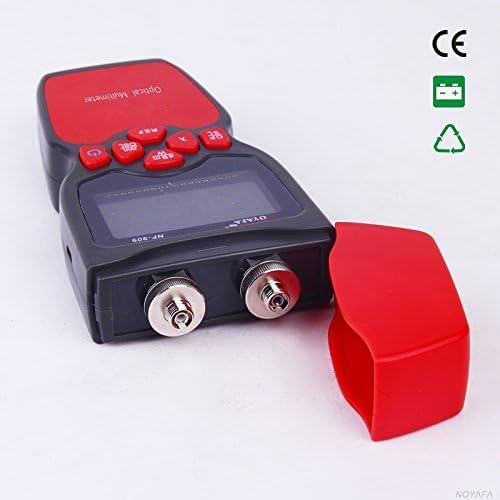
Figi 1: Devan view of the Noyafa NF-909C Fiber Optic Tester. This image shows the device's display screen, the red control buttons (Power, REF, dBm/W, λ, Hz), and the two optical input/output ports on the front, protected by a red cap. The device is black and red.
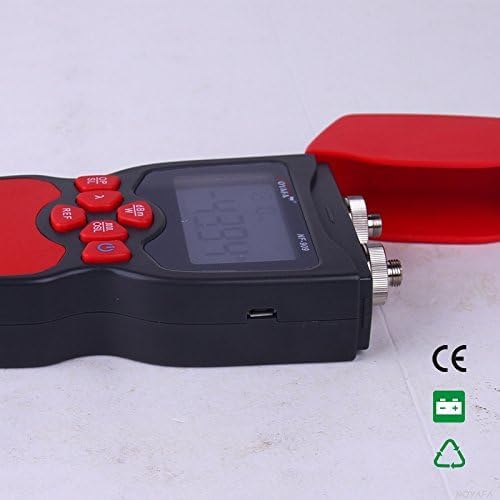
Figi 2: Side view of the Noyafa NF-909C Fiber Optic Tester. This image highlights the micro USB port located on the side of the device, which may be used for power or data transfer, though its primary function is typically for charging or external power supply. The red protective cap is shown detached.
Konpozan kle:
- Ekspozisyon LCD: Shows measurement readings, selected wavelength, unit, and battery status.
- Bouton kontwòl: Power On/Off, Reference (REF), Unit (dBm/W), Wavelength (λ), Frequency (Hz).
- Optical Power Meter Input: Typically supports SC, ST, LC connectors (optional).
- Optical Light Source Output: Typically FC connector (SC, ST, LC optional).
- Lòj batri: Located on the rear, for 3x 1.5V batteries.
- Mikwo USB Port: For power supply or charging (refer to Figure 2).
5. Enstalasyon
5.1 Enstalasyon batri
- Jwenn kouvèti konpatiman batri a sou dèyè aparèy la.
- Glise oswa deklipe kouvèti a pou louvri li.
- Insert three (3) 1.5V AAA batteries, ensuring correct polarity (+/-) as indicated inside the compartment.
- Ranplase kouvèti lòj batri a byen.
5.2 Premye pouvwa sou
Peze epi kenbe la Pouvwa button to turn on the device. The LCD display will illuminate, showing the current mode and settings.
6. Operasyon Enstriksyon
6.1 Optical Power Meter Mode
This mode measures the absolute optical power or relative loss in optical fiber networks.
- Connect Fiber: Connect the optical fiber to be tested to the Power Meter input port. Ensure the connector is clean.
- Chwazi longèdonn: Peze a λ button to cycle through the available calibrated wavelengths: 850nm, 1300nm, 1310nm, 1490nm, 1550nm, 1625nm. Select the wavelength matching your light source.
- View Mezi: The display will show the optical power in dBm.
- Change Unit: Peze a dBm/W button to switch between dBm and W (Watts) units.
- Set Reference (REF): For relative measurements (loss), connect a known good fiber to a stable light source and the power meter. Press the REF button to set the current power reading as the reference (0dB). Subsequent measurements will show the loss relative to this reference.
- Frequency Identification: The power meter can identify modulation frequencies from 10Hz to 60KHz. If the incoming signal is modulated, the frequency will be displayed.
6.2 Optical Light Source Mode
This mode provides a stable optical signal for testing fiber optic cables.
- Connect Fiber: Connect the optical fiber to be tested to the Light Source output port. Ensure the connector is clean.
- Chwazi longèdonn: Peze a λ button to cycle through the available wavelengths: 1310nm and 1550nm. Select the desired wavelength.
- Select Modulation Frequency: Peze a Hz button to cycle through modulation frequencies: 270Hz, 1KHz, 2KHz, or continuous wave (CW).
- Siyal Sòti: The device will emit a stable optical signal at the selected wavelength and modulation.
6.3 Fonksyon Auto-Off
The device features an auto-off function to conserve battery life. If no operation is performed for approximately 15 minutes, the device will automatically power off. Press the Pouvwa bouton pou vire l tounen sou.
7. Antretyen
- Cleaning Optical Connectors: Always ensure optical connectors are clean before use. Use lint-free wipes and appropriate optical cleaning solutions. Dirty connectors can lead to inaccurate measurements and damage to the device or fiber.
- Ranplasman batri: When the battery indicator on the display shows low power, replace all three 1.5V AAA batteries promptly.
- Depo: When not in use, store the device in a dry, cool place, away from direct sunlight and extreme temperatures. Always replace the protective caps on the optical ports to prevent dust and damage.
- Netwayaj ekstèn: Netwaye eksteryè aparèy la ak yon mou, damp twal. Pa sèvi ak pwodui netwayaj abrazif oswa solvang.
NAN. Depanaj
- Aparèy la pa limen:
- Tcheke si pil yo byen enstale ak polarite ki kòrèk la.
- Ranplase ak pil fre.
- Inaccurate power meter readings:
- Ensure optical connectors are clean.
- Verify the selected wavelength on the power meter matches the light source wavelength.
- Check if the fiber under test is properly connected and not damaged.
- No light output from light source:
- Ensure the device is powered on and in light source mode.
- Tcheke nivo batri a.
- Verify the fiber is properly connected to the output port.
- Auto-off activates too quickly:
- The auto-off is fixed at 15 minutes of inactivity. This is normal operation.
9. Espesifikasyon
| Karakteristik | Spesifikasyon |
|---|---|
| Optical Power Meter Module | |
| Detector Measurement Range | -50 ~ +26 dBm |
| Calibrated Wavelengths | 850, 1300, 1310, 1490, 1550, 1625 nm |
| Rezolisyon | 0.01 dBm |
| Identification Frequency Range | 10Hz ~ 60KHz |
| Konektè optik | SC, ST, LC (optional) |
| Optical Light Source Module | |
| Emitter Wavelengths | 1310 / 1550 nm (other wavelengths customizable) |
| Sortie pouvwa | -7 dBm |
| Estabilite Sòti a | 0.05 dB / 15 mins; 0.1 dB / 8 hours |
| Modulation Frequencies | 270 Hz, 1 KHz, 2 KHz |
| Konektè optik | FC (SC, ST, LC optional) |
| Espesifikasyon jeneral | |
| Pwovizyon pou pouvwa | 3 x 1.5V pil AAA |
| Tan Auto-off | 15 minit (environ) |
| Tanperati Fonksyònman | -10 °C ~ +60 °C |
| Dimansyon (L x W x H) | 160 x 75 x 32 mm |
| Pwa | 400 g (unit only) / 150 g (item weight from specs) |
| Minimòm opere Voltage | 1.5 Volts |
| Maksimòm Operating Voltage | 5 Volts |
| Espesifikasyon Met | UL 61010-1, IEC 61010-2-030 |
| Manifakti | Shenzhen Noyafa Electronic |
10. Garanti ak sipò
For warranty information, technical support, or service inquiries, please refer to the warranty card included with your product or contact your authorized Noyafa dealer or the manufacturer directly. Keep your purchase receipt as proof of purchase.


