
Entwodiksyon
Thank you for choosing the VonHaus Electric HVLP Spray Gun. This manual provides essential information for the safe and effective use, maintenance, and troubleshooting of your new paint sprayer. Please read these instructions thoroughly before initial use and retain them for future reference.

The VonHaus Electric HVLP Spray Gun, including the main unit, spray gun attachment, air hose, and cleaning tools.
Enfòmasyon sou Sekirite
AVÈTISMAN: Toujou swiv prekosyon sekirite debaz yo lè w ap itilize aparèy elektrik pou diminye risk dife, chòk elektrik ak aksidan pèsonèl.
- Li tout enstriksyon yo: Familyarize w avèk kontwòl yo ak bon jan pou itilize ekipman an.
- Mete ekipman pwoteksyon pèsonèl (EPI) ki apwopriye: Sa gen ladan l linèt sekirite, yon mask respiratwa, gan, ak rad pwoteksyon.
- Asire bon vantilasyon: Use the spray gun in a well-ventilated area to avoid inhaling fumes.
- Materyèl ki ka pran dife: Pa flite materyèl ki ka pran dife toupre flanm dife, flanm pilòt, oswa lòt sous ignisyon.
- Sekirite elektrik: Ensure the power cord is undamaged and connected to a grounded outlet. Do not expose the unit to rain or wet conditions.
- Kenbe timoun yo ak moun ki prale yo lwen: Do not allow children or untrained persons to operate the spray gun.
- Sere pyès travay la: Always ensure the item being sprayed is stable and secure.
- Netwayaj: Toujou dekonekte kouran an anvan w netwaye oswa fè antretyen.
Pwodwi konpozan
The VonHaus Electric HVLP Spray Gun consists of several key parts:
- Inite motè: The main power unit that generates airflow.
- Flite zam: The handheld component where paint is atomized and sprayed.
- Kawoutchou Air: Connects the motor unit to the spray gun.
- Veso penti: Attaches to the spray gun to hold the paint material.
- Nozzle/Air Cap: Controls the spray pattern.
- Bouton kontwòl koule: Adjusts the volume of paint sprayed.
- Viscosity Cup: Used for measuring paint viscosity.
- Cleaning Brush & Needle: For maintenance and cleaning.

Yon fèmen view of the spray gun's trigger, flow control knob, and adjustable valve, which allow for precise control over paint application.
Enstalasyon
1. Material Preparation (Thinning & Straining)
Proper material preparation is crucial for optimal spray performance and to prevent clogging. Always refer to the paint manufacturer's instructions for thinning recommendations.
- Stir thoroughly: Always stir the spraying material thoroughly before measuring viscosity.
- Measure viscosity: Use the provided viscosity cup. Dip the cup completely into the material and measure the time in seconds until the cup empties. This is the 'Runout Time'.
- eklèsi: If the runout time is too long, thin the material with the appropriate solvent (e.g., water for latex, mineral spirits for oil-based paints) until the desired viscosity is achieved. Do not use materials with a flashpoint below 102°F (39°C). Maximum viscosity: 60 DIN-S.
- Strain material: Always strain the prepared material to remove any impurities or lumps that could clog the nozzle.

Diagram illustrating the use of the viscosity cup and a thinning chart providing recommended runout times for various materials like oil enamel, oil-based primer, oil stain, clear sealer, polyurethane, and varnish.
2. Asanble
- Connect the air hose to both the motor unit and the spray gun securely.
- Fill the paint container with your prepared and strained material.
- Attach the filled paint container to the spray gun, ensuring it is tightly sealed.
- Select the desired spray pattern by rotating the air cap.
Operasyon
1. Ajiste modèl espre yo
The spray gun offers three adjustable spray patterns: horizontal, vertical, and circular. To change the pattern, rotate the air cap to align the 'ears' with the desired orientation:
- Orizontal: Pou flite mouvman monte desann.
- Vètikal: For spraying side-to-side motions.
- Sikilè: For small areas or detailed work.
2. Kontwòl koule
The flow control knob on the spray gun allows you to adjust the volume of paint being sprayed. Turn the knob clockwise to decrease flow and counter-clockwise to increase flow. Always test on a scrap piece of material to find the optimal setting.
3. Teknik flite
- Distans: Kenbe zam espre a apeprè 6-12 pous (15-30 cm) lwen sifas la.
- Mouvman: Move the gun in smooth, even strokes, keeping it perpendicular to the surface. Overlap each pass by about 50% to ensure even coverage.
- Trigger control: Peze deklanche a nèt pou kòmanse flite epi lage l nan fen chak kou.
- Pratike: Always practice on a piece of scrap material to get a feel for the spray pattern and flow before starting your project.

A user demonstrating the VonHaus Electric HVLP Spray Gun in action, applying paint to a wooden surface, showcasing its use for outdoor projects.
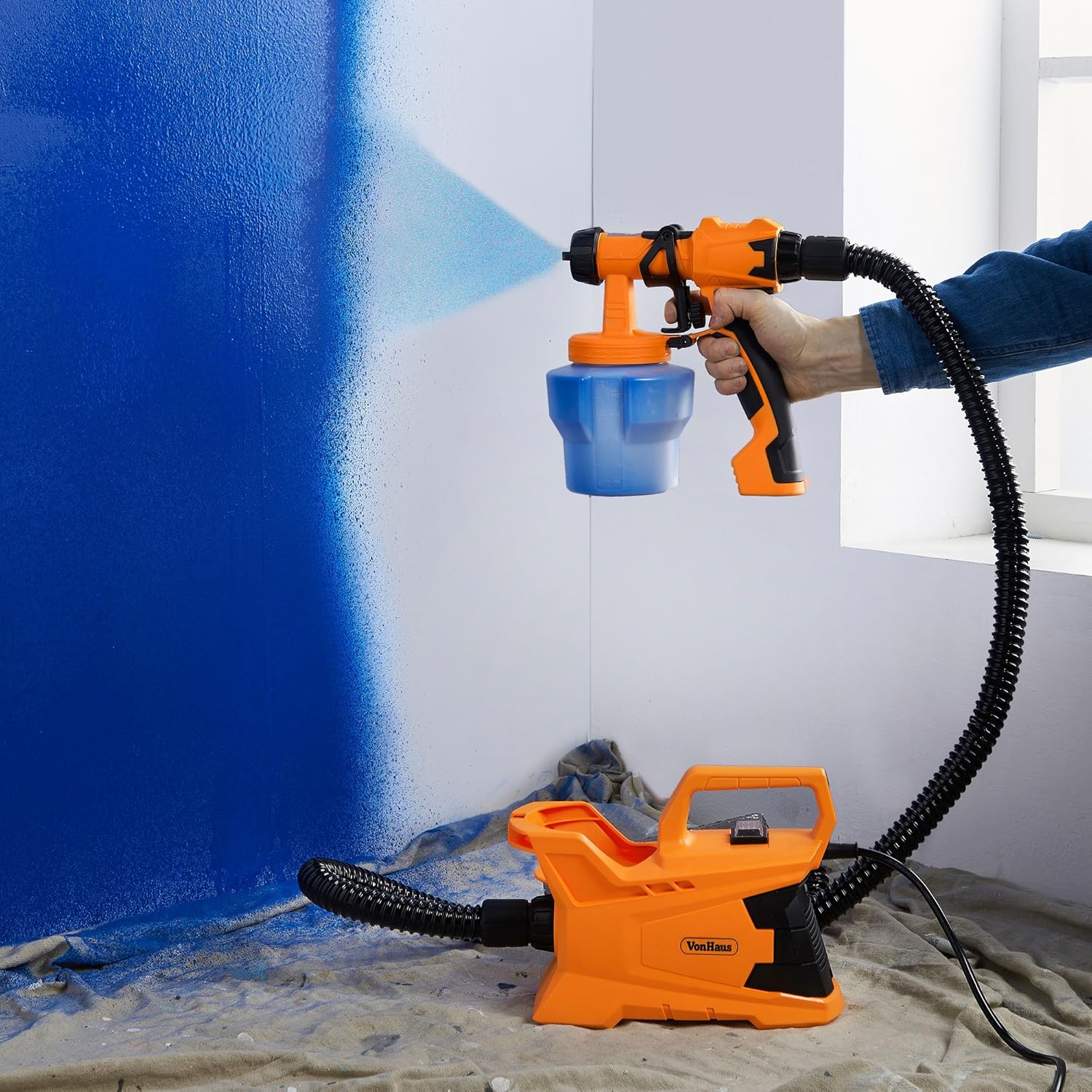
The VonHaus Electric HVLP Spray Gun being used to paint an indoor wall, illustrating its versatility for various painting tasks.
Antretyen
Thorough cleaning after each use is essential to prolong the life of your spray gun and ensure consistent performance.
1. Pwosedi Netwayaj
- Dekonekte kouran an: Toujou deploge aparèy la nan sous kouran an anvan w netwaye.
- Empty container: Empty any remaining paint from the container back into its original can.
- Rinse container: Fill the container with the appropriate cleaning solution (water for latex, solvent for oil-based paints) and spray it through the gun into a waste container until clear.
- Demonte: Unscrew the paint container, remove the air cap, nozzle, and needle.
- Konpozan pwòp: Use the provided cleaning brush and needle to thoroughly clean all disassembled parts, including the container, air cap, nozzle, and fluid tip. Pay special attention to small holes and crevices.
- Wipe down: Wipe the exterior of the spray gun and motor unit with a damp twal.
- Dry and reassemble: Ensure all parts are completely dry before reassembling the spray gun.

A user cleaning the paint container and spray gun components under running water in a sink, demonstrating the ease of post-project cleanup.
2. Depo
Store the cleaned and reassembled spray gun in a dry, cool place, away from direct sunlight and out of reach of children.
Depanaj
| Pwoblèm | Kòz posib | Solisyon |
|---|---|---|
| Pa gen espre oswa espre fèb | Clogged nozzle/fluid tip; Insufficient material; Air hose disconnected; Motor unit not running. | Clean nozzle/fluid tip; Refill container; Check air hose connection; Ensure power is on and motor is running. |
| Modèl espre inegal | Incorrect air cap setting; Material too thick; Partially clogged nozzle. | Adjust air cap; Thin material further; Clean nozzle thoroughly. |
| Paint spitting or dripping | Material too thin; Nozzle loose; Air cap not seated correctly; Low material level. | Thicken material slightly; Tighten nozzle; Re-seat air cap; Refill container. |
| Motor unit overheating | Prolonged continuous use; Blocked air vents. | Allow unit to cool down; Clear any obstructions from air vents. |
Espesifikasyon
- Mak: VonHaus
- Modèl: B079TYFFZY
- Non Style: Zam
- Modèl espre: 3 (Horizontal, Vertical, Circular)
- Kontwòl koule: Reglabl
- Viskozite maksimòm: 60 DIN-S (approximate, refer to thinning chart)
Garanti ak sipò
For warranty information or technical support, please refer to the documentation provided at the time of purchase or contact VonHaus customer service directly. Keep your proof of purchase for any warranty claims.
For further assistance, visit the official VonHaus websit oswa kontakte ekip sipò kliyan yo.